The Astronomer-King of Samarkand: Ulugh Beg
Caption
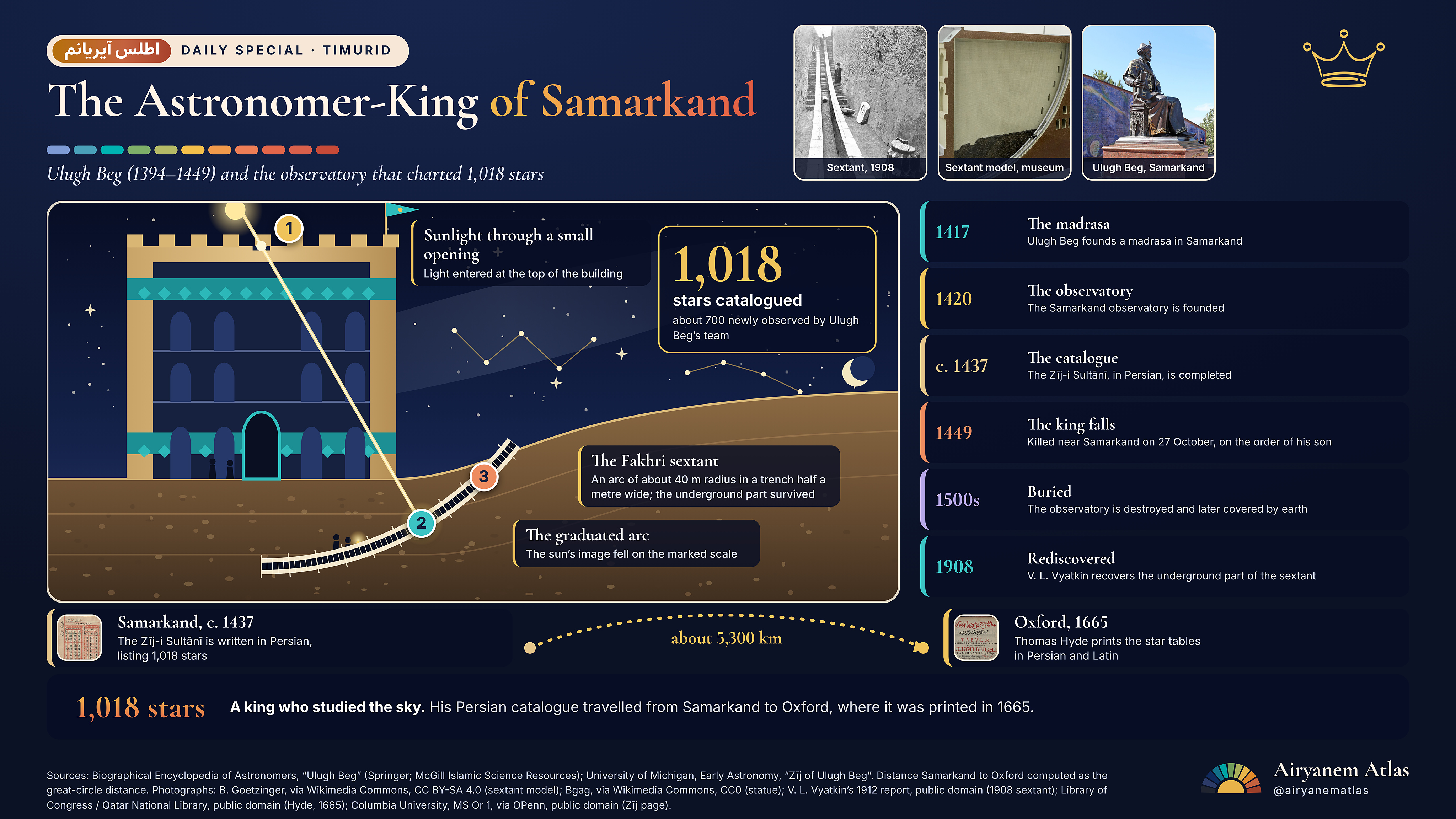
Ulugh Beg, the astronomer-king of Samarkand (born 22 March 1394, killed 27 October 1449). His observatory, founded in 1420, held the Fakhri sextant: an arc of about 40 m radius set in a trench half a metre wide. His Persian Zīj-i Sultānī lists 1,018 stars, and Thomas Hyde printed it at Oxford in 1665, in Persian and Latin. #UlughBeg #Samarkand #Timurid #Astronomy
Short takes
The Fakhri sextant of Samarkand was an arc of about 40 m radius sunk in a trench half a metre wide. Sunlight entering a small opening above cast the sun's image on its graduated scale.
Ulugh Beg's Persian star catalogue lists 1,018 stars. About 700 positions rest on his own team's observations; the rest derive from Ptolemy in one or both coordinates.
The observatory was later destroyed and buried. In 1908 the archaeologist V. L. Vyatkin recovered the underground part of the sextant. Hyde's Oxford edition of the catalogue had already appeared in 1665.
Photo credits: B. Goetzinger, via Wikimedia Commons, CC BY-SA 4.0 (sextant model); Bgag, via Wikimedia Commons, CC0 (statue); V. L. Vyatkin's 1912 excavation report, public domain (1908 sextant); Library of Congress / Qatar National Library, public domain (Hyde, 1665); Columbia University, MS Or 1, via OPenn, public domain (Zij page).
Image description
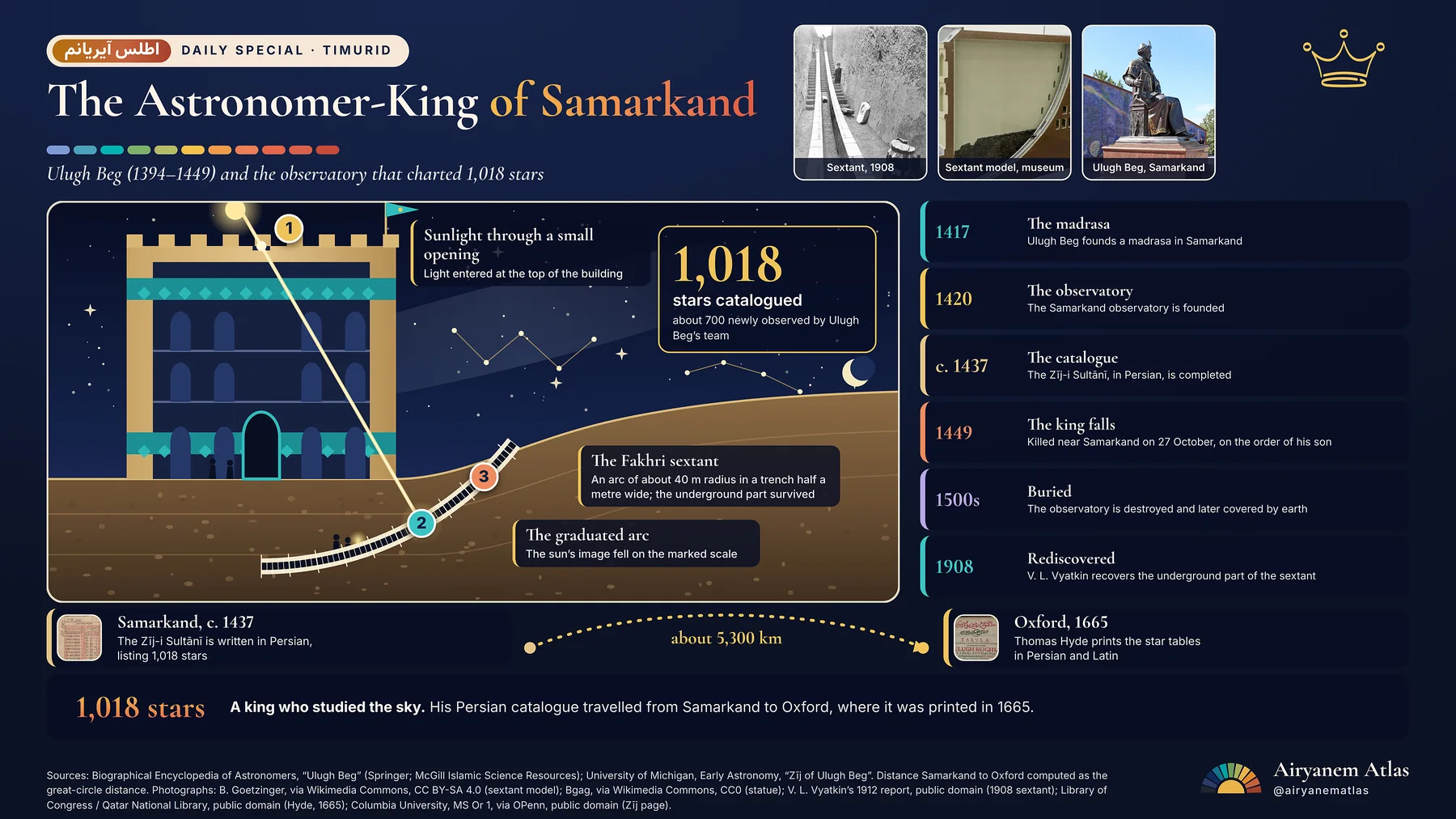
Dark blue night-sky infographic titled The Astronomer-King of Samarkand with a gold crown. A cutaway shows a sandstone observatory with teal tile bands. A sunbeam enters a small opening on the roof and runs down to a graduated arc sunk in a trench in the ground, labelled the Fakhri sextant, about 40 m radius. A box reads 1,018 stars catalogued, about 700 newly observed. A timeline lists 1417 madrasa, 1420 observatory, c. 1437 catalogue, 1449 the king killed, 1500s buried, 1908 rediscovered. A strip shows Samarkand c. 1437 to Oxford 1665, about 5,300 km, where Hyde printed the Persian catalogue. Bar: 1,018 stars.