Life Before the Medes at Qareh Tepe
Caption
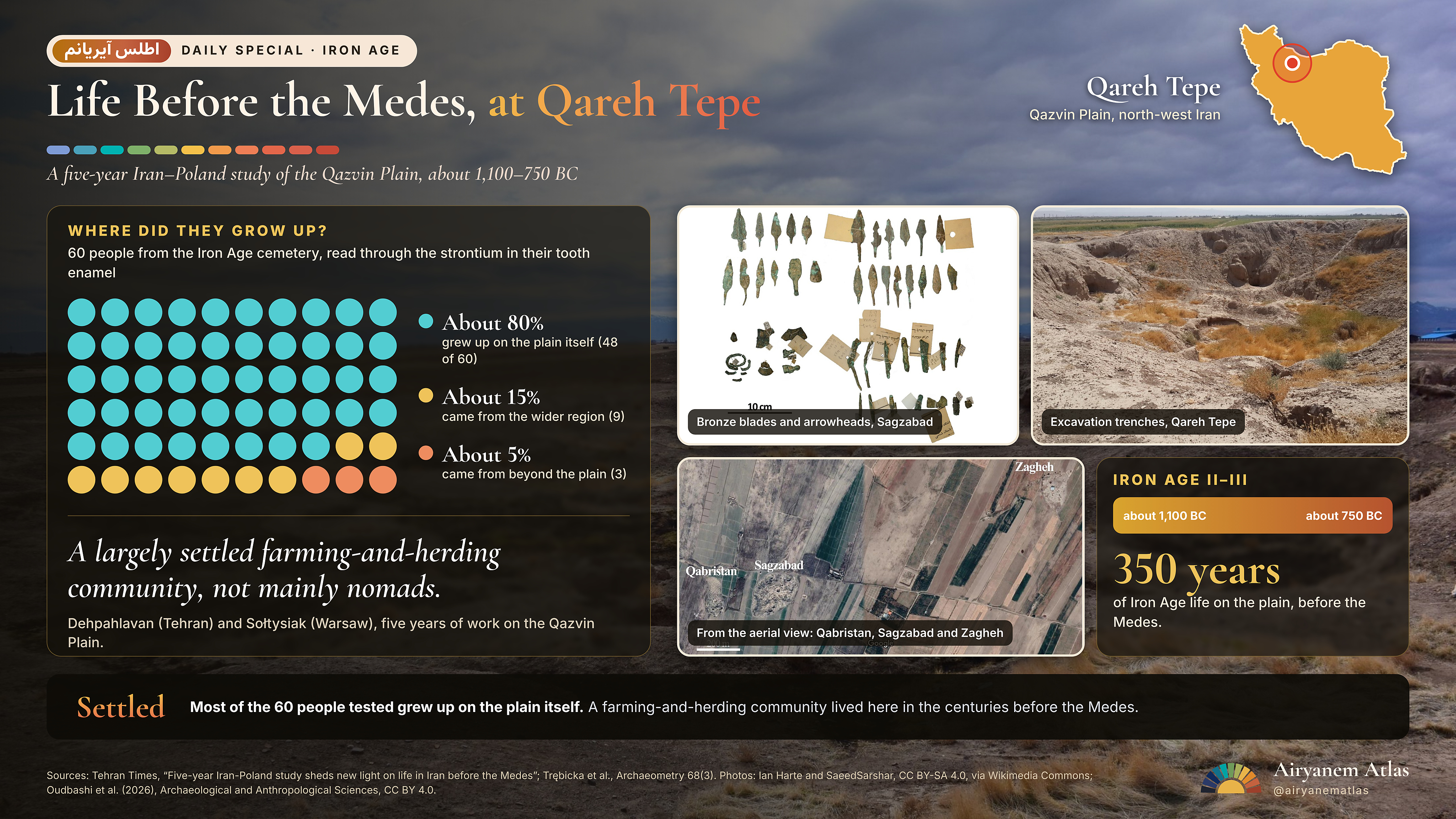
Life before the Medes: a five-year Iran–Poland study at Qareh Tepe on the Qazvin Plain (c. 1100–750 BC) describes a largely settled farming-and-herding community, not mainly nomads. About 80% of 60 people tested grew up on the plain. #Iran #Archaeology #IronAge
Short takes
Tooth-enamel strontium shows where people spent their childhood. At Qareh Tepe, of 60 individuals tested, about 80% grew up on the Qazvin Plain, about 15% came from the wider region and about 5% from farther away. #Iran #Archaeology
A five-year Iran–Poland project (Dehpahlavan of Tehran, Sołtysiak of Warsaw) studied life on the Qazvin Plain before the Medes. What would you most like to know about a farming village almost 3,000 years ago? #Iran #IronAge
Image description
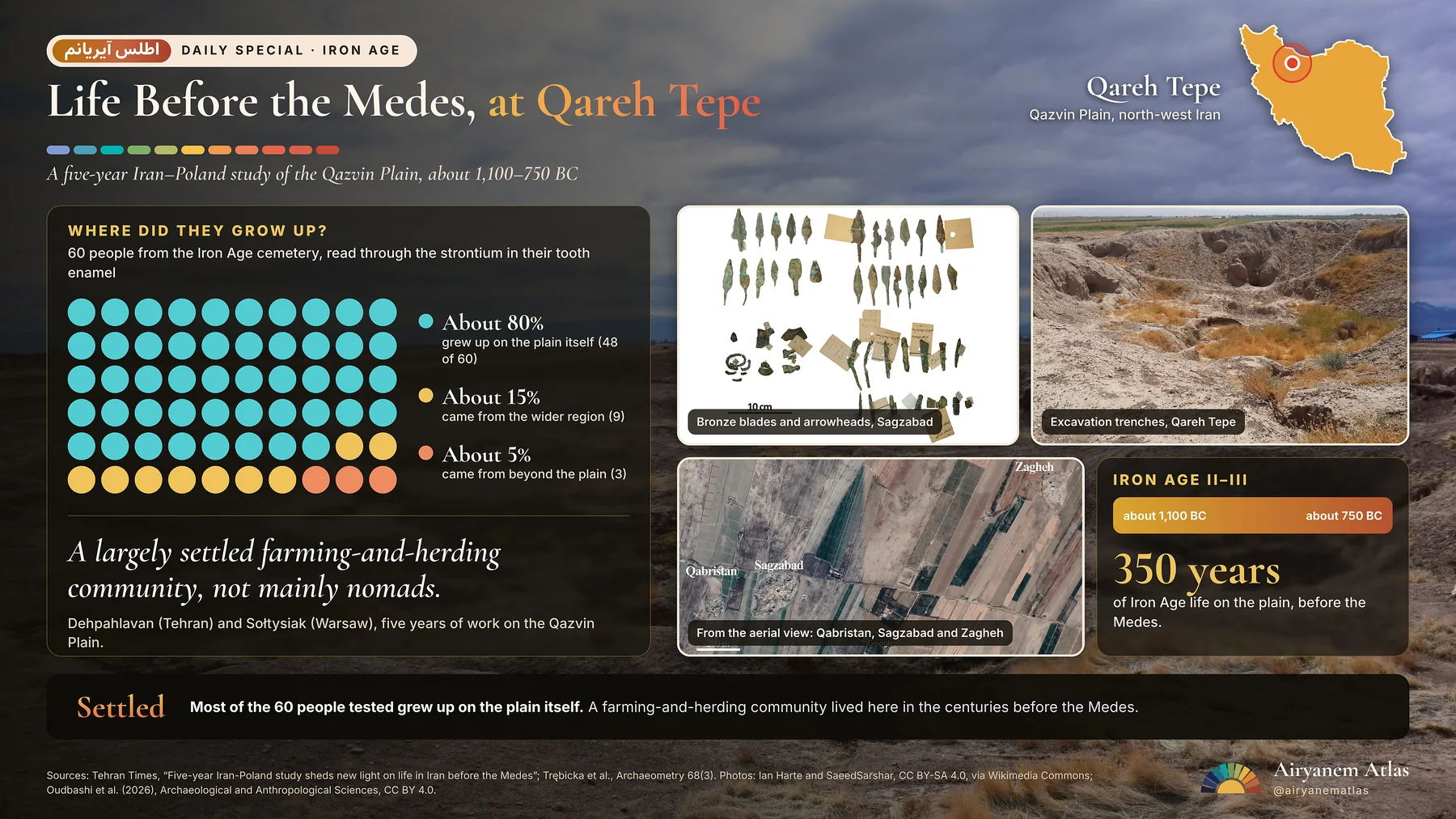
Infographic titled Life Before the Medes, at Qareh Tepe, over a full-width photograph of the Sagzabad mound on the Qazvin Plain. Left panel: a grid of 60 dots shows where people from the Iron Age cemetery grew up, by the strontium in their tooth enamel: 48 teal dots, about 80%, on the plain itself; 9 gold dots, about 15%, from the wider region; 3 orange dots, about 5%, from beyond the plain. Below it: a largely settled farming-and-herding community, not mainly nomads, studied by Dehpahlavan of Tehran and Sołtysiak of Warsaw. Right: photographs of bronze blades and arrowheads from Sagzabad, excavation trenches at Qareh Tepe, and an aerial view of Qabristan, Sagzabad and Zagheh, plus a bar for Iron Age II–III, about 1,100 to 750 BC, and the figure 350 years. Takeaway: settled.