Inside the Cyrus Cylinder
Caption
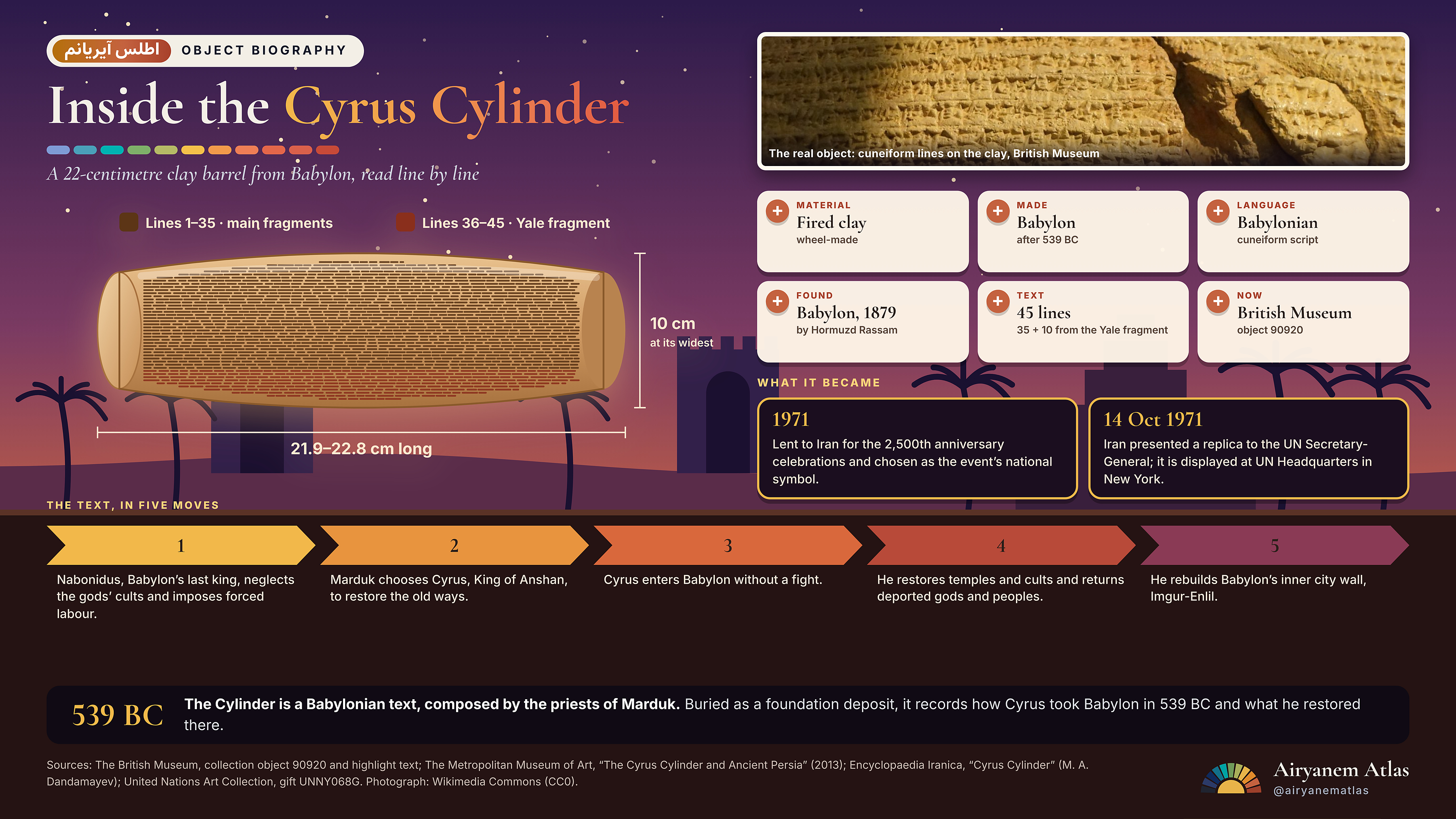
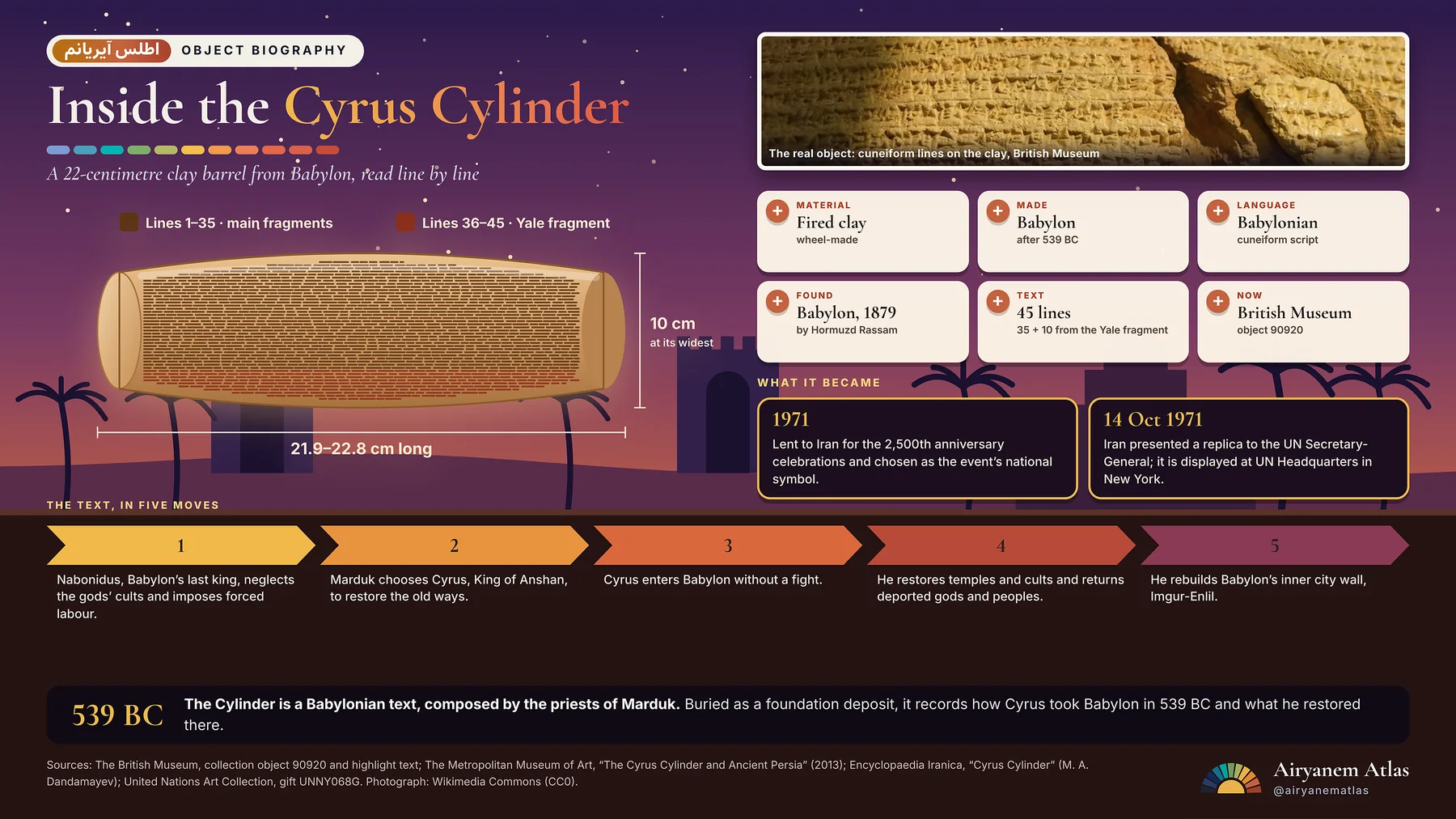
Inside the Cyrus Cylinder. A 22 cm fired-clay barrel found in Babylon in 1879, with 45 lines of Babylonian cuneiform. It tells how Cyrus entered Babylon in 539 BC without a fight and restored temples and cults. A replica stands at UN Headquarters in New York. #CyrusCylinder #Cyrus #Achaemenid
Short takes
The Cyrus Cylinder is written in Babylonian, not Old Persian. It was composed in Babylon and buried as a foundation deposit, a message to the future.
The Cylinder says Cyrus rebuilt Babylon’s inner city wall, Imgur-Enlil. A conqueror’s text about bricks and temples.
In 1971 the Cylinder travelled to Iran for the 2,500th anniversary celebrations. The same year, a replica was presented to the UN Secretary-General.
Image description
Infographic Inside the Cyrus Cylinder. A drawn clay barrel with 45 lines of cuneiform, lines 1 to 35 marked as main fragments and 36 to 45 as the Yale fragment, with dimensions 21.9 to 22.8 cm long and 10 cm wide. Six fact cards cover material, place, language, discovery in 1879, 45 lines, and the British Museum. Five numbered steps summarise the text, and two cards cover the 1971 loan and the UN replica. A bar reads 539 BC.