A Board Game from the Burnt City
Caption
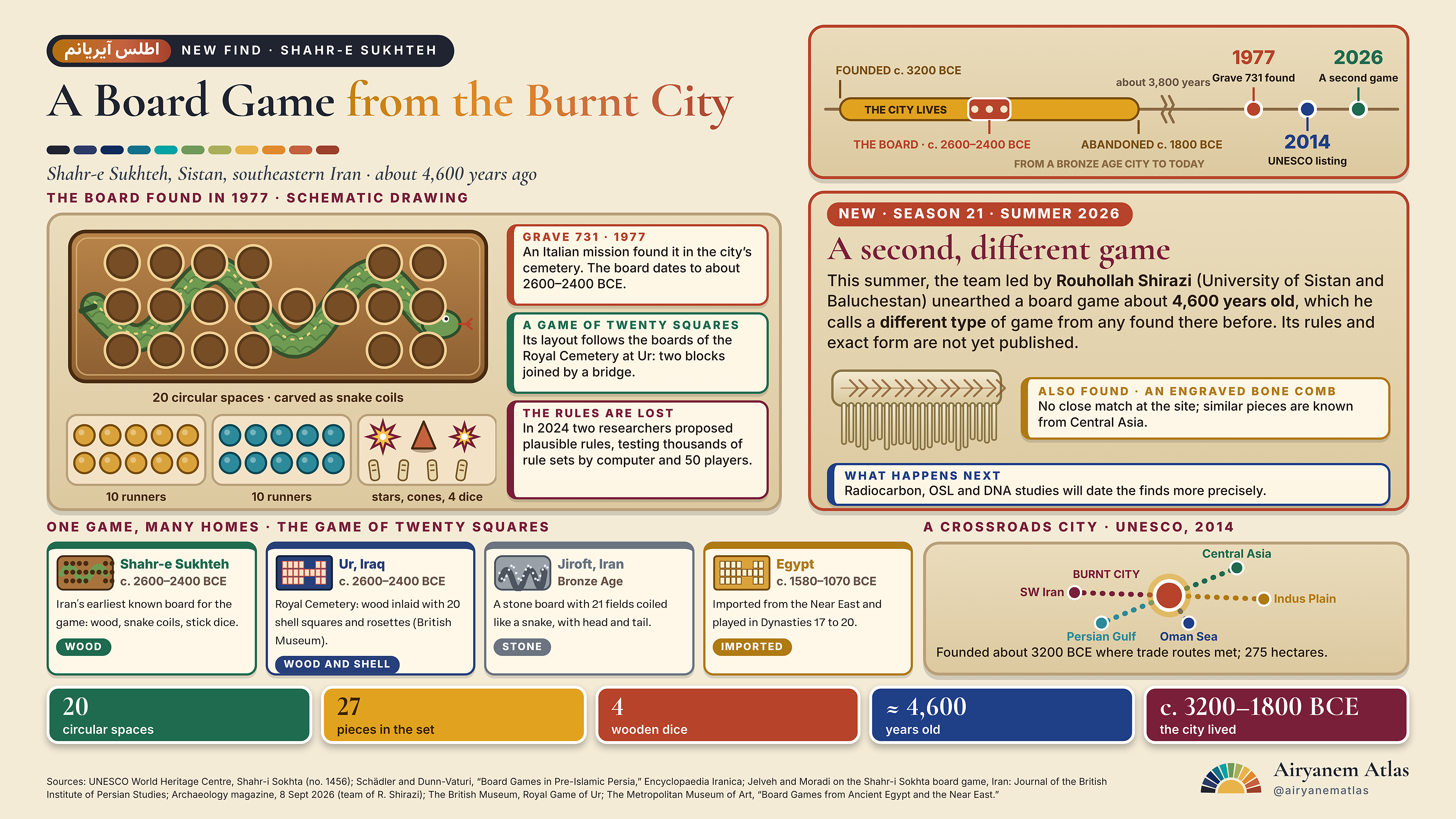
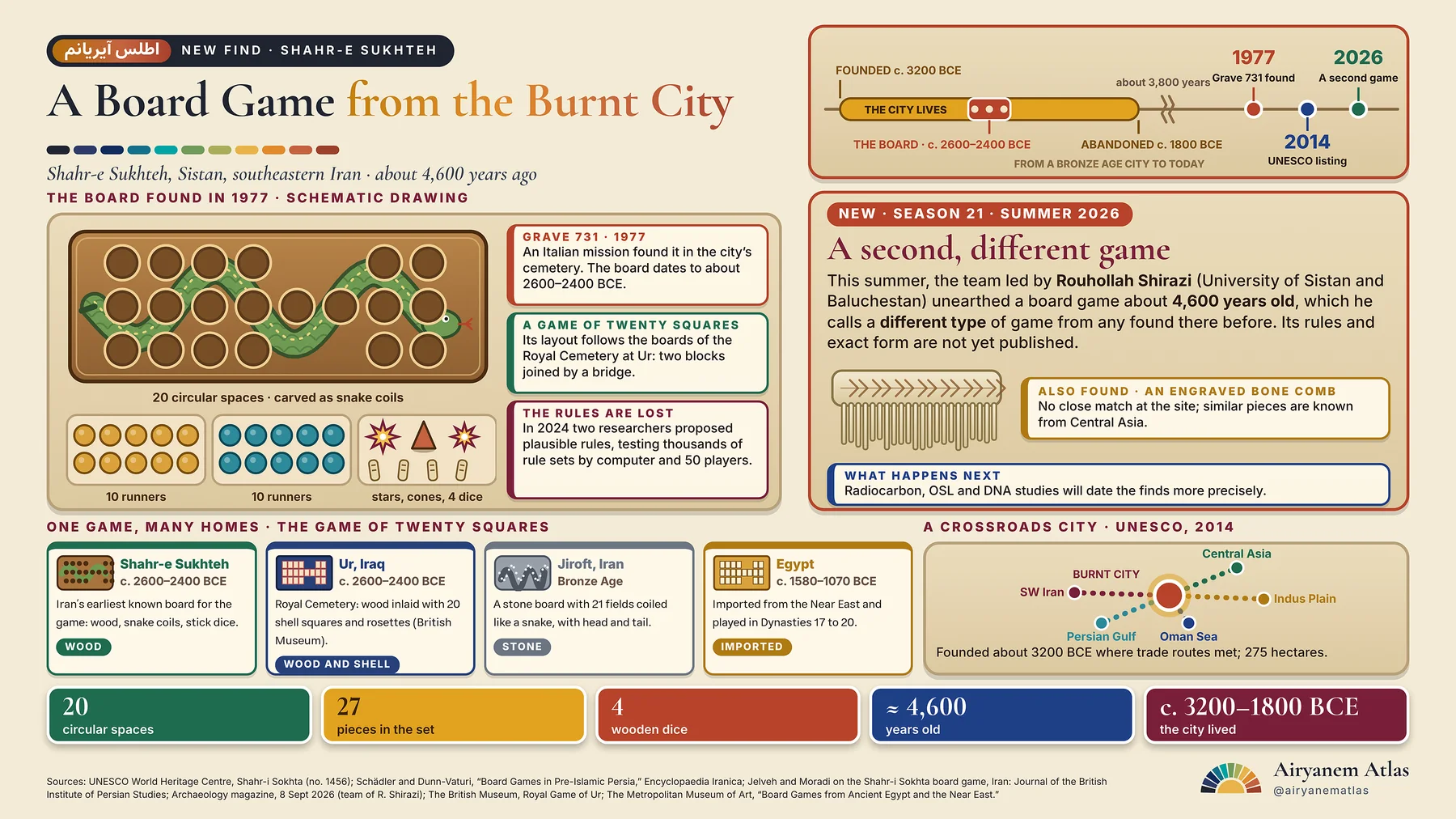
A board game from the Burnt City. From Grave 731 at Shahr-e Sukhteh came a carved board with 20 circular spaces, 27 pieces and four dice (c. 2600–2400 BCE), kin to the Royal Game of Ur. In 2026 the dig found a second, different game, about 4,600 years old. #Iran #Archaeology
Short takes
Twenty squares, four dice, no rulebook. The Burnt City board was buried about 4,500 years ago and its rules are lost. In 2024 researchers tested thousands of rule sets by computer, then 50 players, to propose plausible ones. How would you play it?
One game, many homes: the Game of Twenty Squares was played at Ur in Iraq about 2600 BCE, at Shahr-e Sukhteh in Iran, at Jiroft on a stone snake board, and in Egypt in Dynasties 17 to 20. Shahr-e Sukhteh holds Iran’s earliest known board for the game.
Image description
Infographic titled A Board Game from the Burnt City. A drawing of a wooden board shows 20 round spaces with a green snake winding between them, with trays of 10 gold runners, 10 teal runners, star and cone pieces and four dice sticks. Text notes Grave 731, found in 1977, and the lost rules. A panel on the 2026 season notes a different board game about 4,600 years old and an engraved bone comb. Cards compare Twenty Squares boards at Shahr-e Sukhteh, Ur, Jiroft and Egypt. A timeline runs from the city's founding about 3200 BCE to the 2026 find. A diagram shows trade routes to Central Asia, the Indus, the Gulf and the Oman Sea. Tiles read 20 spaces, 27 pieces, 4 dice, about 4,600 years.